AI and Virtual Production: Why Universities Should Consider Them Together

With university capital budgets under increasing pressure, investment in artificial intelligence (AI) is understandably becoming a major priority. At the same time, universities are looking to modernise their film, television and digital media facilities to reflect changing industry practices.
But should AI laboratories and virtual production studios really be viewed as separate investments competing for the same funding?
As AI becomes increasingly integrated into film, television, animation and immersive media production, there is a growing argument for universities to consider these technologies together. A carefully planned virtual production or creative media studio could support not only traditional production teaching but also AI-assisted content creation, research, simulation and collaboration across multiple academic departments.
The challenge is to develop facilities that are technically appropriate, financially realistic and flexible enough to adapt as technologies evolve.
How AI Is Changing Film, Television and Virtual Production
Artificial intelligence is already influencing the way moving-image content is conceived, developed and produced.
AI-assisted tools are increasingly being used for concept development, storyboarding, pre-visualisation, image and environment generation, animation, visual effects and post-production. These technologies can help creative teams explore ideas, develop alternative visual approaches and accelerate elements of the production process.
In virtual production, AI-generated or AI-assisted content can contribute to the development of digital environments, textures and other visual assets used within real-time production workflows.
However, generating an environment or visual asset is not the same as having a production-ready virtual set. Content may still require significant artistic development, technical optimisation, integration with real-time rendering software and consideration of intellectual property rights.
Equally, AI does not remove the need for physical production facilities.
Cameras, lighting, acoustic environments, recording equipment, production galleries, tracking systems and reliable audio-visual infrastructure remain essential. What is changing is the relationship between these physical systems and the software technologies used to create and manipulate content.
For universities, this creates an opportunity to develop facilities that support both established production techniques and emerging AI-assisted workflows.
Bringing AI, Virtual Production and Creative Research Together
Traditionally, university facilities are often developed around the requirements of individual academic departments. Film and television, computing, animation, games design and digital media may each have their own teaching spaces, equipment and capital investment priorities.
Yet there is increasing overlap between these disciplines.
A virtual production studio could support film and television teaching while also providing a practical environment for research into AI-generated content, real-time graphics, interactive environments, motion capture and immersive technologies.
Similarly, students and researchers developing AI-based creative applications could benefit from access to professional studio infrastructure in which to test their work.
Potential applications extend beyond traditional screen production. Architecture, digital performance, interactive design, simulation and other research activities may benefit from facilities that combine physical environments with real-time digital content.
Of course, not every AI laboratory needs a production studio, and not every virtual production facility requires dedicated AI computing infrastructure. The important question is whether there are shared teaching, research or operational requirements that would justify a coordinated approach.
For university estates teams and academic decision-makers, identifying these opportunities at an early stage may help produce a stronger business case for investment.
Virtual Production Doesn’t Have to Mean an Expensive LED Volume

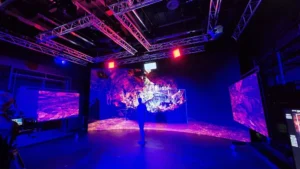
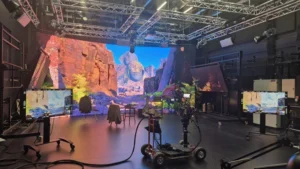
Virtual production is frequently associated with large LED screens displaying computer-generated environments behind performers or presenters.
Although LED volumes can provide significant creative and production benefits, they also represent a substantial investment in equipment, building infrastructure and ongoing technical support.
For many universities, a more flexible and affordable starting point may be a well-designed green-screen studio.
Green Screen Studios
A professionally designed green-screen studio provides a controlled environment for filming subjects against a chroma-key background, allowing digital environments to be incorporated into the final image.
These facilities can support conventional film and television production alongside AI-assisted content creation and digital compositing.
Successful green-screen studio design requires careful consideration of the available shooting space, lighting uniformity, background construction, camera positions, colour spill, acoustics and technical infrastructure.
Importantly, green-screen studios can also form part of a wider virtual production strategy.
Camera Tracking and Real-Time Production
By incorporating camera tracking, suitable computing infrastructure and real-time rendering technology, a green-screen studio can be developed to support more advanced virtual production workflows.
Camera tracking allows the movement and position of a physical camera to be reflected within a computer-generated environment, helping maintain the correct perspective as the camera moves.
This opens opportunities for students to work with real-time virtual sets, interactive environments and more sophisticated visual effects.
For some teaching and research applications, this may provide much of the required functionality without the cost and complexity of a large LED volume.
LED Virtual Production Studios

Where there is a clear academic, research or commercial requirement, an LED virtual production stage may be appropriate.
However, designing these facilities involves considerably more than selecting the size and resolution of an LED screen.
Considerations include screen geometry, pixel pitch, camera tracking, viewing distances, real-time rendering infrastructure, video synchronisation, production lighting, electrical power, cooling, structural support, acoustics and operational access.
The relationship between these systems has a significant influence on the facility’s performance, flexibility and long-term running costs.
Selecting the appropriate solution therefore requires a detailed understanding of the intended production workflows, rather than beginning with a particular technology or equipment specification.
Planning Flexible, Future-Ready Studio Facilities
One of the biggest challenges when investing in studio technology is the speed at which production equipment and software develop.
Universities may be planning facilities with an operational life of 15 to 20 years, while individual technology platforms and equipment systems can change considerably within that period.
This makes flexibility particularly important.
Rather than designing a facility around a fixed equipment list, universities should consider the underlying infrastructure needed to support evolving production requirements.
This includes adequate studio dimensions and working heights, adaptable lighting grids, accessible equipment spaces, technical power, structured cabling, audio and video distribution, acoustics, ventilation and opportunities for future expansion.
Where virtual production is anticipated, early consideration should also be given to camera tracking coverage, rendering and processing requirements, structural capacity, equipment cooling and the possible future introduction of LED displays.
Not every studio needs to be immediately equipped for every conceivable technology. In some cases, a phased development strategy may be more appropriate:
- Initial investment: Develop a flexible film or television studio with professional lighting, cameras, sound systems, control facilities and reliable technical infrastructure.
- Enhanced production capability: Introduce real-time rendering, camera tracking, motion capture or other technologies as teaching and research requirements develop.
- Further expansion: Consider LED volumes or additional immersive production technologies where there is a demonstrated requirement and a sustainable operational business case.
The appropriate sequence will differ between institutions, and some facilities may never require an LED volume.
Nevertheless, considering potential future requirements during the initial building design can help avoid expensive alterations and unnecessary disruption later.
Making Better Use of University Capital Investment
For universities, the decision to invest in a new AI facility, virtual production studio or immersive media laboratory should begin with the academic and operational requirements, rather than the technology itself.
Before committing substantial capital funding, it is worth establishing several important questions:
- Which teaching programmes, research activities and academic departments would use the proposed facility?
- Could existing or planned AI, computing and production resources be shared?
- What production workflows and technical capabilities are genuinely required?
- Would a conventional or green-screen studio meet the immediate needs, or is an LED volume justified?
- What are the implications for building design, space allocation, staffing, maintenance and future upgrades?
- Could the project be developed in phases to spread expenditure and reduce the risk of technological obsolescence?
These questions are particularly important when different departments are preparing competing capital funding proposals.
A coordinated feasibility study may reveal opportunities to share physical spaces, technical infrastructure or operational resources, although the extent of any benefit needs to be tested against actual requirements.
It may also demonstrate that separate facilities are the most appropriate solution, but with common infrastructure or a coordinated development strategy.
Either way, informed technical planning can help universities make better investment decisions and develop more realistic project budgets.
The Value of Independent Studio Design Consultancy
The early stages of a studio development project are often the most important.
Decisions about room dimensions, ceiling heights, lighting infrastructure, acoustic isolation, technical spaces and building services can have long-term implications for the facility’s performance and adaptability.
These decisions may need to be made well before detailed equipment specifications are available.
Independent specialist studio design consultancy can help universities, architects and project teams establish the requirements and assess the options before committing to a particular technical solution.
This can include:
- Consultation with academic departments and key users to establish a coordinated technical brief.
- Feasibility studies and option appraisals for green-screen, television, broadcast and virtual production studios.
- Assessment of opportunities for shared facilities, future expansion and phased investment.
- Development of outline technical designs, infrastructure requirements and indicative capital budgets.
- Coordination with architects, structural engineers, acoustic consultants and building services designers.
- Preparation of technical specifications, tender documentation and independent review of proposed equipment and systems.
Crucially, this allows the facility to be developed around its intended users and operational requirements, rather than being driven solely by the capabilities of a particular equipment manufacturer or systems integrator.
How Drama by Design Can Help
Drama by Design provides independent specialist consultancy for the feasibility, planning and technical design of television, film, broadcast, green-screen and virtual production studios.
Working with universities, architects and professional clients, we help develop practical studio facilities that balance creative ambitions, technical requirements, available budgets and long-term flexibility.
Our experience includes television and film studios, green-screen production facilities, recording studios, virtual production environments and associated control rooms and technical infrastructure.
We work alongside architectural and engineering design teams to ensure that production lighting, audio-visual systems, acoustics, camera infrastructure, technical power and operational workflows are properly integrated into the wider building design.
For universities considering investment in AI-enabled creative production facilities, we can also provide early-stage feasibility and technical planning advice to help establish the most appropriate approach before capital funding decisions are made.
Looking Ahead
AI and virtual production are likely to become increasingly interconnected as creative production workflows continue to evolve.
For universities, this presents an opportunity to think more strategically about how film, television, immersive media and AI-related research facilities are planned and developed.
The objective should not necessarily be to create the most technologically advanced studio from day one, but to develop facilities that meet current needs while remaining adaptable to future developments.
By considering AI and virtual production together where there is a genuine academic or operational benefit, universities may be able to make better use of their capital investment, encourage collaboration between disciplines and develop more flexible teaching and research environments.
Planning a new television, green screen or virtual production studio?
Drama by Design can provide independent specialist consultancy from initial feasibility and technical briefing through to detailed design, procurement and project delivery.
Find out more about our Studio Consultancy services or contact us to discuss your project.